
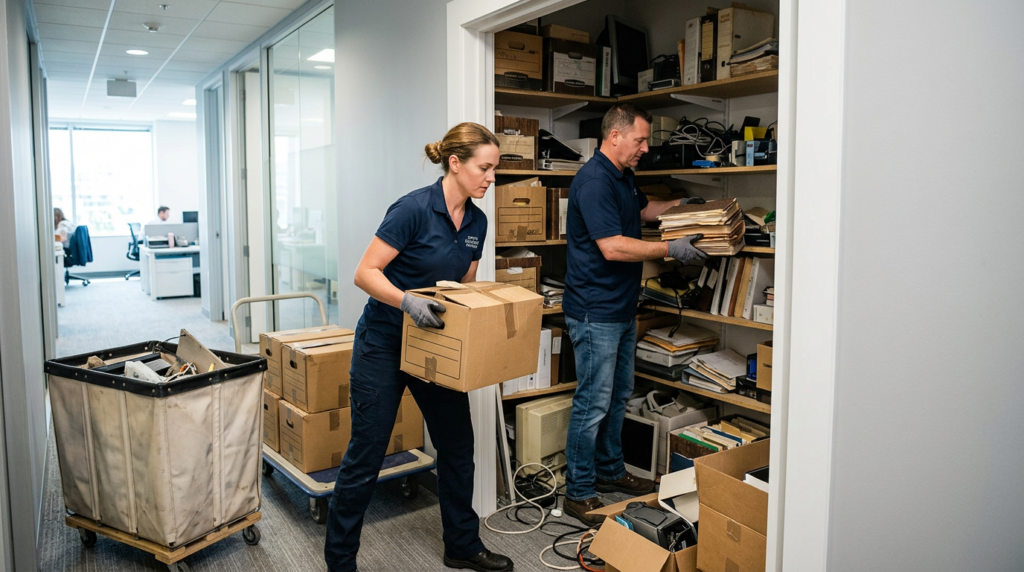
Every office has one. That closet nobody opens unless absolutely necessary, the one where old printers go to die and boxes of paperwork from three moves ago still sit untouched. At Lansing Junk Removal, we’ve opened more of these closets than we can count, and I can tell you they all have a story. Some are harmless time capsules. Others are genuine safety hazards waiting to fall on someone reaching for a stapler. Either way, these forgotten storage spaces are exactly why office cleanout services exist, and why so many businesses in the Lansing area finally decide to call in help.
Why That Closet Got So Bad In The First Place
Nobody plans for a storage closet to become a disaster zone. It happens slowly. Someone shoves a broken chair in there “temporarily.” A department reorganizes and dumps old binders on the shelf. A new hire doesn’t know where anything goes, so they default to the closet because it’s easier than asking. Multiply that by a few years and a couple of staff turnovers, and you’ve got a room nobody wants to claim responsibility for.
The Ownership Problem
In most offices, storage closets fall into a weird gray zone. They don’t belong to any one department, so no one feels obligated to clean them. Facilities staff assume it’s not their job unless there’s a fire code violation. Office managers have a hundred other priorities. Meanwhile, the closet keeps filling up because it’s the path of least resistance for anything nobody wants to deal with directly.
The Emotional Weight Of Old Stuff
There’s also a strange psychological hurdle at play. Old files might contain something important. That broken printer might get fixed someday. Those promotional banners from a trade show five years ago might get reused. People hold onto things out of uncertainty, and that uncertainty compounds until the closet is packed floor to ceiling with items nobody can quite justify keeping or tossing.
What These Closets Usually Hide
After years of doing this work throughout Lansing, I’ve developed a pretty good sense of what’s behind those doors before I even open them. It’s rarely a surprise, but it’s always a lot.
- Outdated electronics like fax machines, CRT monitors, and tangled cable boxes
- Stacks of paper records that should have been shredded years ago
- Broken office furniture nobody had time to haul away
- Cleaning supplies that expired before half the current staff was hired
- Random promotional items from events long forgotten
None of this is unusual. It’s just the natural byproduct of a busy workplace where storage decisions get made in a hurry and revisited never.
The Real Cost Of Letting It Pile Up
A messy closet seems like a low priority problem until it isn’t. I’ve walked into offices where a closet door wouldn’t fully close because of the pressure from everything crammed inside. That’s not just inconvenient. It’s a liability.
Safety Risks Hiding In Plain Sight
Overloaded shelving can collapse. Boxes stacked too high can fall on someone reaching for something on a lower shelf. Old electronics sometimes contain batteries that degrade over time and pose fire risks. A cluttered closet near an HVAC unit or electrical panel can even violate fire code requirements, something the National Fire Protection Association outlines in detail when it comes to maintaining clear access to critical building systems.
Wasted Square Footage
Office space costs money, whether it’s owned or leased. A closet stuffed with junk is space that could be used for actual storage, extra supplies, or even repurposed as a small breakroom nook. Businesses often don’t realize how much usable space they’re sacrificing until the clutter finally gets cleared.
The Productivity Drain
There’s also a quieter cost. Employees who need something from that closet waste time digging through piles to find it. Some give up entirely and just buy a replacement, which means the company is now paying twice for the same item. It’s a small inefficiency that adds up more than most managers realize.
Why Teams Avoid Tackling It Themselves
I get it. Cleaning out a storage closet sounds simple until you’re standing in front of it with no idea where to start. It’s not laziness. It’s usually a mix of logistics and priorities.
Nobody Has The Time
Office staff already have full plates. Asking someone to spend their afternoon sorting through years of accumulated junk isn’t realistic when they’ve got actual job responsibilities waiting.
Heavy Lifting And Awkward Loads
Old furniture and electronics are heavy, bulky, and sometimes just plain awkward to move. Without the right equipment or manpower, it’s easy for someone to get hurt trying to haul a broken file cabinet down a hallway.
Uncertainty About Disposal Rules
Some items can’t just go in a regular dumpster. Electronics often require special recycling. Paper records might need secure shredding rather than standard disposal. Without knowing the rules, teams often let the closet sit rather than risk doing it wrong.
How A Professional Cleanout Actually Works
When a business calls Lansing Junk Removal about a closet cleanout, the process is a lot less complicated than most people expect.
The Walkthrough
The first step is always a quick assessment. I look at what’s inside, figure out what can be donated, recycled, or needs special handling, and give a straightforward estimate before anything gets touched.
The Sort And Removal
From there, the team gets to work sorting items into categories. Anything reusable gets set aside for donation. Electronics get routed to proper recycling facilities. General junk gets hauled out efficiently, often in a fraction of the time it would take in-house staff to do the same job.
The Final Clean Sweep
Once everything’s out, the space gets swept and left ready for whatever the office wants to do with it next. Some businesses turn the space into extra storage for current materials. Others use it for supplies, seasonal decorations, or simply leave it open and breathable for the first time in years.
Turning A Forgotten Closet Into Usable Space Again
The most satisfying part of this work is seeing a space transform. A closet that used to make people groan when they opened it becomes something functional again. Businesses often tell me they had no idea how much room they actually had until the clutter was gone.
Office cleanouts don’t have to be a massive undertaking or a project that gets pushed to next quarter for the tenth time. A little outside help clears the backlog fast, keeps staff safe, and gives the office back a space that’s actually useful. That closet everyone avoids doesn’t have to stay that way forever, and it definitely doesn’t have to be tackled alone.